foster-miller

The Reuters News Kill-Bot Report

by Socrates
Thumbnail image for The Reuters News Kill-Bot Report

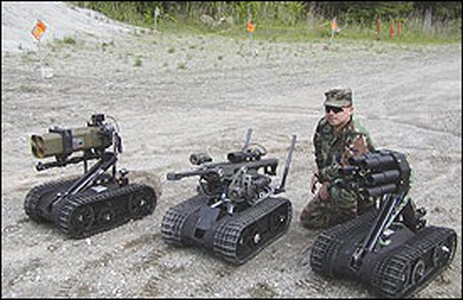
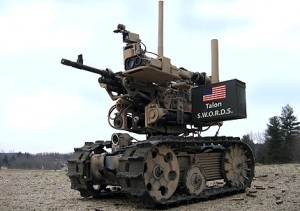
I have posted before on different types of smart weapons for the 21st century. For example, in a 5 part series of articles titled Dawn of the Kill-Bots (see Part 1; Part 2; Part 3; Part 4; Part 5) I argued that despite the high media coverage of the conflicts in Iraq and Afghanistan what we are (not) witnessing is the rise of armed military robots capable of killing humans. There I claimed that within the history of the human species those conflicts may eventually turn out to be known as the dawn of the kill-bots – the period during which increasingly self-sufficient machines became capable of and started making increasingly autonomous decisions about killing human beings. Thus I speculated that the conflicts in Iraq and Afghanistan may turn out to be a lot more than merely a chapter in [...]

Read the full article →

The Rise of Robotic Artificial Intelligence

by Socrates

Here is a fascinating video interview with Prof. Noel Sharkey Sheffield University professor of robotics and AI. Prof. Sharkey discusses the rise of robots and Artificial Intelligence and the implications thereof. One particularly important area is the ethical issues of arming robots and using them in armed conflicts such as Iraq and Afghanistan. (This interview raises questions that were previously discussed in the Dawn of the Kill-Bots series.) Artificial intelligence: Noel Sharkey on the inexorable rise of robots | silicon.com Related articles by Zemanta Call for debate on killer robots (news.bbc.co.uk) Call for debate on killer robots (innovationtoronto.com) Military killer robots ‘could endanger civilians’ (telegraph.co.uk) Expert Warns Of ‘Terminator’ Robot Threat (news.sky.com)

Read the full article →

Best of Singularity Blog

by Socrates

Even though it has been only a bit more than a month since the beginning of this blog I am happy to note that there is already a tight group of people who have subscribed to my feed and continue to come back and read my posts on a regular basis. I want to take this opportunity to do 2 things: First and foremost I want to thank you all for the generous gift of your interest, your time and your moral support. I cherish those dearly and promise to do my best to provide you with more interesting, more relevant and better written singularity content during the new 2010. In the end, without you — my readers, both the Singularity Weblog and the Singularity Symposium website will be not only pointless but will cease to exist. It is your [...]

Read the full article →

Dawn of the Kill-Bots: the Conflicts in Iraq and Afghanistan and the Arming of AI (part 4)

by Socrates
Thumbnail image for Dawn of the Kill-Bots: the Conflicts in Iraq and Afghanistan and the Arming of AI (part 4)

Part 4: Military Turing Test — Can robots commit war-crimes? Now that we have identified the trend of moving military robots to the forefront of military action from their current largely secondary and supportive role to becoming a primary direct participant or (as Foster-Miller proudly calls its MAARS bots) “war fighters” we have to also recognize the profound implications that such a process will have not only on the future of warfare but also potentially on the future of mankind. In order to do so we will have to briefly consider what for now are assumed to be broad philosophical but, as robot technology advances and becomes more prevalent, will eventually become highly political, legal and ethical issues: Can robots be intelligent? Can robots have conscience? Can Robots commit war crimes? In 1950 Alan Turing introduced what he believed was [...]

Read the full article →

Dawn of the Kill-Bots: the Conflicts in Iraq and Afghanistan and the Arming of AI (part 1)

by Socrates
Thumbnail image for Dawn of the Kill-Bots: the Conflicts in Iraq and Afghanistan and the Arming of AI (part 1)

Warfare, while seemingly the opposite of large scale industrial production, in so far as it is usually perceived to be large scale destruction, exhibits most if not all of the main characteristics of the capitalist mode of production. Features such as specialization, personal discipline within an ethos of team spirit, standardization of procedures, processes and products, are characteristic of both war and modern production. Whether it is more proper to say that warfare has been industrialized or that capitalist production has been militarized is an interesting and important question,  yet regardless of the answer it is evident that robots can be successfully applied both to the production process of capitalism as well as the destruction process of war. Just like its cousin the manufacturing robot has the capacity to produce more products per unit of time compared to a worker, [...]

Read the full article →