
 “Look Mom, no hands!” might not only be a phrase used for excited young bicyclists but may also translate onto speedy and congested highways if a group of Artificial Intelligence German researchers perfect their latest project—brain-powered vehicles.
The team of researchers, who work for AutoNOMOS innovation labs in Freie Universitat Berlin, are in the midst of compromising a technological system called the BrainDriver that will make all of those pesky tasks like using hands and feet to steer and brake obsolete. Drivers will also be able to spark the ignition, turn left and right, and accelerate or decelerate simply using their brain waves.
Sounds like something ripped out the pages of a H.G. Wells novel right? Well if lead researcher Paul Rojas and his colleagues can work out all the kinks in their state-of-the-art technology, then the steering wheel might just well be on its way of turning into a relic of the past.
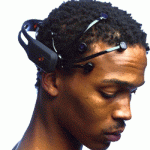
So how will these brain-driven cars work, exactly? As explained in the video below, drivers will be required to wear the Emotiv EPOC neuroheadset. This headset is equipped with 16 sensors that have the ability to decode electromagnetic signals—more specifically those that can understand brain patterns that are linked to comprehending the directional commands mentioned above. Granted (aside from the headset) the vehicle itself will have additional features—including laser and radar sensors and video cameras.
[youtube]https://youtu.be/iDV_62QoHjY[/youtube]
While a delayed response rate between the thinking and command action currently seems to be the biggest flaw, there are other major issues of concern that researchers have not addressed such as: what about all of the drivers with ADHD and those with road rage? Have these groups of people, including many others, been factored into the system? What are they suppose to say if an accident were to occur due to road rage for example? “I’m sorry officer; I didn’t really mean to ram my front end of the car into the back of that vehicle. I only ‘thought’ about accelerating.”
On the other hand, while surely there are still flaws that researchers need to work on, this brain driven car can do wonders for others—especially disabled people who many no longer have the use of limbs and legs.
While the concept of brain-driven cars is currently under development, researches warn that we will not be seeing them on the streets just yet. “This is just proof of a concept,” researches state in the instructional video. “The task here was to show free driving by detecting brain patterns. There is still a long way to go until we can take full control of the machines with our brains.”
About the Author:
This guest post is contributed by Tara Miller, who has completed her Bachelors in Psychology. She particularly enjoys writing about psychology degree. Questions or comments can be sent to: [email protected].
Related articles


 but also for
  , the Island of Crushed Ships and
  In his