Salim Ismail: We Are Already Gods, We Might As Well Start Acting As Such
Socrates / Podcasts
Posted on: September 11, 2011 / Last Modified: December 2, 2021
Podcast: Play in new window | Download | Embed
Subscribe: RSS
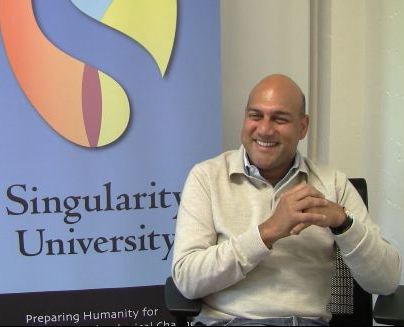 During my time at Singularity University, I was privileged to get a 30 min interview with Salim Ismail for Singularity 1 on 1.
During our conversation we discuss issues such as Salim’s personal background and early childhood in India; his motivation, goals, and aspirations for Singularity University; the term “exponential organization”; his take on the technological singularity and the surprising fact that he is not a singularitarian; being/becoming gods; our responsibility for what happens to the planet; religion in general and the rapture of the nerds’ criticism in particular; making money and investing; being Canadian; using technology to address humanity’s grand challenges.
I would like to thank Singularity University for allowing me to use their campus during filming.
Hope you enjoy watching the interview as much as I enjoyed talking to Salim!
As always you can listen to or download the audio file above or scroll down and watch the video interview in full. To show your support you can write a review on iTunes, make a direct donation, or become a patron on Patreon.
Who is Salim Ismail?
Salim Ismail is a sought-after speaker, strategist, and entrepreneur based in Silicon Valley. He travels extensively addressing topics including breakthrough technologies and their impact on a variety of industries.
Salim spent the last three years building Singularity University as its founding Executive Director and current Global Ambassador. SU is based at NASA Ames and is training a new generation of leaders to manage exponentially growing technologies. Before that, he built and ran Brickhouse, Yahoo’s internal incubator. His last company, Angstro, was sold to Google in August 2010. He has founded or operated seven early-stage companies including PubSub Concepts, which laid some of the foundation for the real-time web. Salim also serves on the board of Breakthrough, a global human rights organization.
Related articles