Of Mice, Men, The Singularity and Playing Dice with the Universe

The story of mice and men is still unfolding.
But the end doesn’t have to turn out the way we think it will.
Robert Burns’ original poem To a Mouse reads:
“The best laid schemes of mice and men
Go often awry,
And leave us nothing but grief and pain,
For promised joy!”
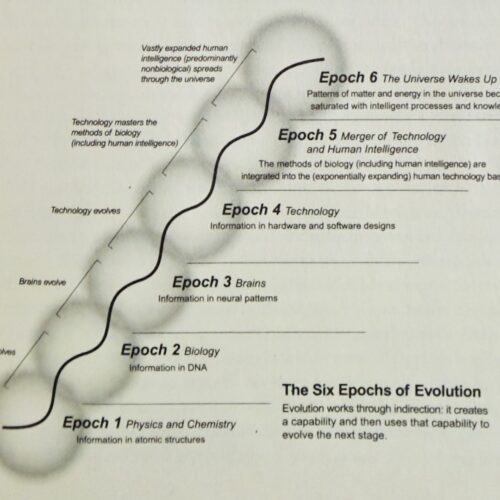
And so, en route to the singularity, can our grandiose plans to become immortal, super-intelligent, god-like beings turn out to be “the promised joy” that went awry?
After all, it’s been said that “Life is what happens to us while we are making other plans.”
And so, even “the best laid schemes” come with no guarantee about the outcome. Indeed, “grief and pain” often (or is it always?!) come along with the “promised joy.” That is why “attachment” and “desire” are the ultimate sources of suffering according to Buddhism.
On the one hand – nothing gets accomplished without emotional attachment and total commitment to the outcome. On the other – those can (especially in the case of failure) and often do lead to “grief and pain.”
It seems that the only way to avoid the negatives will be to make sure nothing goes awry. Hence we make our “best laid” plans.
But can we control the outcome?
Einstein himself was a determinist who thought that we merely appear to have free will while, in fact, we don’t. He simply refused to accept that God might play dice with the Universe by allowing for random events (and chance) to ruin the perfectly good cosmic order of cause and effect. It is for this reason that, despite all the evidence, to his very dying day Albert refused to embrace quantum mechanics and strove to find a single, unified, non-random, cause-and-effect theory of everything. (For more on that see Einstein: His Life and Universe)
If Einstein was right, then, one way or the other, the fate of mice and wo/men (as well as that of the singularity and the cosmos) has already been determined by all the preceding events in the cosmic cause-and-effect chain. Taking this a step further, techno-determinists believe that the singularity is inevitable and we might as well get ready for it (and the coming utopia).
But if Einstein was wrong (and God is dead), then, anything is possible.
To me this is the more likely (and interesting) scenario.
While things can go awry they really don’t have to. Especially if we have made the effort to lay the best possible plans. Again, this doesn’t guarantee success but certainly raises the probabilities. Add a little random chance (or luck) and anything is possible, including things going flawlessly well. (Mark Twain once observed that the difference between fiction and reality is that fiction has to be believable.)
To conclude, in contrast to Einstein I very much believe that God does play dice with the universe.
In our cosmic casino of life, civilizations are born, live and die with the roll of the dice.
This time we get to roll the dice. And the more adept at technology we are the more we can change the rules and rig the game in our own favor.
And so the die is cast.
Let the chips fall where they may for we are likely beyond the point of no return.
We’ve got one-way-tickets on spaceship Earth and, whether we reach any destination or not, I am enjoying the ride.
Carpe diem!