
Steven Kotler on We Are As Gods: Godlike Power, Stone Age Minds
Socrates / Podcasts
Posted on: April 6, 2026 / Last Modified: April 6, 2026
Podcast: Play in new window | Download | Embed
Subscribe: RSS
 We have godlike technology.
Do we have godlike responsibility to match?
In this third conversation with Steven Kotler — our first in 14 years — we dig into his latest book, We Are As Gods: A Survival Guide for the Age of Abundance, co-written with Peter Diamandis. And while the book makes a powerful case for abundance, I came prepared to challenge it.
Because abundance without purpose, as Kotler himself argues, is not salvation. It is a different kind of crisis.
The evidence is already in. John Calhoun’s Universe 25 experiment created a perfect mouse utopia — unlimited food, water, and space, with no predators. The population boomed. Then society collapsed completely. Not from scarcity. From the absence of challenge and meaning. Calhoun’s haunting conclusion, quoted in the book: there is no logical reason a comparable sequence could not unfold for a species as complex as man.
This is why it is a survival guide.
I also push back on what has — and hasn’t — aged well from the original Abundance: the techno-philanthropist thesis, the formula of capital plus people plus technology, and whether the explosion of AI is actually delivering on the promise — or accelerating the dark side.
As the Dalai Lama put it: “We don’t need more intelligence. We need more compassion.”
And as Jerry Seinfeld added: “We’re smart enough to invent AI, dumb enough to need it, and so stupid we can’t figure out if we did the right thing.”
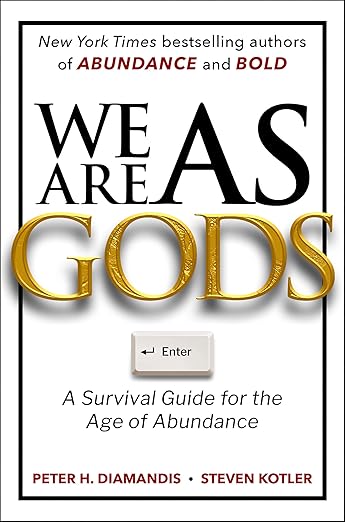 We explore all of this — and more:
- What “We Are As Gods” actually means — promise, aspiration, warning, or choice?
- What the original Abundance got right — and what Kotler now regrets
- The techno-philanthropist thesis: visionaries or new robber barons?
- AI: overhyped, underpowered, and why the backlash is a mark of sanity
- Cognitive offloading and what we risk losing when machines think for us
- Why sustained large-scale cooperation is the killer app of the exponential age
- Flow, lateral thinking, and what AI simply cannot do
- Imagination as the final frontier — and whether it is already being colonized
What struck me most about this conversation was how much we agree. For 16 years, I have argued that technology is the How, not the Why. That without the right Why, even the most powerful How does more damage than good. Kotler not only agrees — he builds on it. Cooperation at scale, he argues, requires a shared mental model, a collective Why, without which no amount of godlike technology will save us. And on the dark side of abundance, on the dangers of cognitive offloading, on the gap between our power and our wisdom to apply it — we find ourselves, repeatedly and sometimes surprisingly, on the same page.
I hope you enjoy my interview with Steven Kotler as much as I did. As always, you can listen to or download the audio file above or scroll down and watch the video interview in full. To show your support, you can write a review on iTunes, make a direct donation, or become a patron on Patreon.
Who is Steven Kotler?
Steven Kotler is an American journalist, award-winning author, and entrepreneur, recognized globally for his work in human performance, neuroscience, and the science of flow states. He holds a degree in English and creative writing from the University of Wisconsin–Madison.
Kotler has authored numerous nonfiction books — including The Rise of Superman, Stealing Fire, The Art of Impossible, and, together with Diamandis, Abundance and Bold.
Beyond writing, Kotler is the founder and executive director of Flow Research Collective — a leading organization researching peak performance, creativity, and human potential.
His journalistic work has appeared in major publications like Wired, The New York Times Magazine, TIME, and others.
Known for blending scientific insight, storytelling, and practical advice, Kotler has helped popularize the concept of “flow” — the state of peak creativity and productivity — and inspired many to explore human performance beyond conventional limits.