• Skip to main content
  • Skip to primary sidebar
  • About
  • Blog
  • Book
singularityweblog-create-the-future-logo-thumb
  • Podcast
  • Speaker
  • Contact
  • About
  • Blog
  • Book
  • Podcast
  • Speaker
  • Contact

singularity music

Music in the Age of Spiritual Machines

March 2, 2011 by wpengine

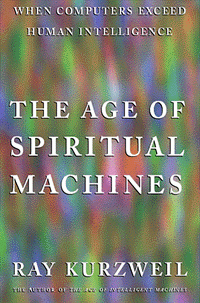
Ray Kurzweil’s 1999 book The Age of Spiritual Machines has a metallic, semi-reflective cover. One way to interpret this stylistic choice has been to think of the cover as a metaphor for the rest of the book in that it is meant to reflect the future of humanity; literally.

When looking at the cover, one sees a metallic version of oneself. Kurzweil predicts that we will merge with machines so that the human race becomes a hybridization of man and machine, of biological and non-biological.

The cover is a figurative mirror test for human-machine consciousness. When looking at the cover, one sees one’s future self.

When Kurzweil first proposed that machines would be spiritual, his view was met with strong criticism. Many academics and theologians rejected the idea altogether, claiming that Kurzweil really didn’t understand spirituality, or, that accepting his thesis required redefinition, a ‘devaluation’ of the word ‘spiritual.’

Since then it seems we have been gradually accepting his viewpoint on this.

One harbinger of ideological change in culture occurs with a shift in the artistic community. Art reflects social norms and beliefs, but it can also portend them.

There is a long list of artists whose work has been inspired directly by Kurzweil’s ideas and more and more, musical artists are addressing the Singularity. These include: Our Lady Peace; The Foals; Paul Dempsey; Yeasayer and Bright Eyes.

For example, Arc of Time, a 2006 song by Bright Eyes, alludes to the potential spiritual nature of ‘mind uploading.’ The lyrics discuss the spiritual epiphany of being ‘born again,’ making an analogy between being ‘born again’ as a Christian and being ‘born again’ on a circuit board. On a circuit board, Bright Eyes writes, spiritual epiphany might be limitless, as one can be ‘born again’ over and over:

“To the deepest part of the human heart

The fear of death expands

Until we crack the code we have always known

But could never understand

On a circuit board we will soon be born

***

Again and again and again and again…

Paul Dempsey has written a song about Ray Kurzweil’s fictional avatar alter ego ‘Ramona,’ emphasizing the beauty and limitless nature of future beings with lines like:

“Eyes like crystal balls

That just won’t shut up

About the future of the future”

Paul Dempsey – Ramona was a Waitress from Bart Borghesi on Vimeo.

In addition to music being written about the spiritual aspects of the Singularity, there are machines producing music now that could be considered ‘spiritual.’

David Cope created Emily Howell in the 1990s. Emily can compose new pieces of music that sound as if written by Beethoven, Bach and others by finding patterns in the composer’s style and replicating those patterns in new compositions. Howell produced its own CD of ‘original’ work entitled From Darkness, Light, which was met with varied reviews.

Human-machine interfaces used in making music have become more nuanced as of late, allowing us to better envision how the human spirit can be preserved in the ‘human-machine’ hybrid.

Accomplished artists such as Brian Eno have gone on record against human-machine interfaces when it comes to making really meaningful music. In an interview with Pitchfork last year, Eno gave a critique of electronic instrumentation for its inability to capture the subtle kinesthetic intelligence being exerted in musical expression.

But there is growing evidence that the limitations in this facet of human-machine interaction are temporary and perhaps very soon to be eliminated.

Steven Mann’s Hyradulophone gives a glimpse into the kinds of interfaces we can expect in the future, where ‘tactile’ information coming from us can be preserved in the interaction with devices. Mann is not on his own with these engineering goals, high precision ‘haptic’ interfaces are being developed in all realms of human-machine interaction.

Are we witnessing the early evidence of machines becoming spiritual? Are we beginning to think of the Singularity in a spiritual way as Kurzweil proposed in 1999?

It is true that there is more to human spirituality than is embodied in artistic expression. But the production of art is admittedly an important aspect of human spirituality.  The first evidence of human spirituality is thought by many anthropologists to correlate with the appearance of artifacts.

Ultimately, spiritual expression on the part of machines will be something we will know when we see it. Like consciousness, a Turing Test will only tell us so much about a machine’s status with regards to spirituality. We will know when machines stop imitating spirituality and actually start embodying it.

It seems we are well on track to the future that Kurzweil predicted in 1999, and many people outside the Singularity community itself are beginning to recognize the spiritual potential of machines.

The development of spiritual insight on the part of machines will create an intimate and profound connection between machines and us.

The mirror stage in human beings leads to a profound connection between body and self, between the ‘mechanistic’ and the mind.

Like the recognition of the mind as the operator of the body, recognizing a spiritual nature in a machine will lead to a unity between man and machine important to many tasks that humans and machines will face together in the future.

About the Author:

Nikki Olson is a writer/researcher working on an upcoming book about the Singularity with Dr. Kim Solez, as well as relevant educational material for the Lifeboat Foundation. She has a background in philosophy and sociology, and has been involved extensively in Singularity research for 3 years. You can reach Nikki via email at [email protected].
Related articles
  • Post Human Era: Music For The Singularity
  • Mr. Roboto By The Styx: Is This Singularity Music?
  • Top 3 Robot Music Videos

Filed Under: Op Ed Tagged With: singularity music

Post Human Era: Music For The Singularity

November 11, 2010 by wpengine

For the past five years, I have been researching primarily two subjects:  The increasing rate at which technology advances; and the changing music industry.  Ideas slowly started to form during this research, and it hasn’t been until now that I have felt like I fully understood how they might work together in unison.  I am a multi-instrumentalist producer first and foremost, and my projects Post Human Era and Ancient Lasers (with Daniel Anderson of Idiot Pilot) strive to close the gaps between these two areas of research.

I was thinking about this: Why do people pay money to download music?

Music is almost free whether you like it or not.  It no longer costs thousands of dollars to make a good record, just knowledge and good software.  Trying to fight music piracy and stomp out torrent sites will only make you look like a dick – people are trying to download your music, so why try to stop them?

So I came up with a new way to monetize the music industry, and I’m using this new method for the upcoming Post Human Era album.  You might call it the Help Me Help You Method.  Here’s how it works:

Let’s say I give you the option to download my music for free.  The money stays in your pocket, I don’t get any, and the economy is relatively unaffected by the transaction. No harm done.  Yet on a grand scale, there is no way that the music industry would be able to survive in its current iteration for more than a few more years.

Now what if I told you that, based on the research I’ve done over the years, it is very likely that this generation of humanity could conceivably live forever through the implementation of technology into our biological systems.  This is obviously assuming we avoid a large number of civilization-ending cataclysms.  Does that excite you?  If you want to know exactly what I mean, I like using a simple example.  Computer size.  Since the 1970’s, computers have been growing in computational power and shrinking in size and price at a fairly consistent rate.  Extrapolate that out into the future and you have computers the size of red blood cells floating around in our blood stream, reversing the process of aging, even backing our consciousness up onto a hard drive so that it never fades away.  See?  Living forever.

The way this ties into the Help Me Help You Method is that I am proposing a certain percentage of music revenue be distributed to organizations that are conducting this kind of research, like Singularity University, Lifeboat Foundation, and Singularity Symposium to name a few.  Imagine rerouting all that revenue away from monetary dead ends like major record labels, towards these research organizations.  You, as a consumer, would have a direct effect on how fast these life-extending changes would take place.  The reason I suggest these organization over others like Red Cross or Doctors Without Borders is because of artificial intelligence.  Once we have computers that are more intelligent than human beings, they will be able to solve global problems millions of times faster than they are solved today.  This is why we must make the construction of these machines the top priority – because if we build these machines successfully, everything that follows will be like nothing we have ever seen before in human history.

Enter the Post Human Era.

About the Author:

Daniel Finfer is a multi-instrumentalist producer for the groups Post Human Era and Ancient Lasers, and is also a graphic artist, writer, video producer, clam linguine expert, and time travel enthusiast.

Other Similar Articles:

I Am The Very Model Of A Singularitarian

Mr. Roboto by the Styx: Is this singularity music?

Filed Under: Op Ed, Video Tagged With: singularity music

Charlie Kam: the Very Model of a Singularitarian

February 16, 2010 by Nikola Danaylov

This is by far one of the most hilarious, smartest and most melodic singularity videos that I have seen.

If you need a little cheer up to brighten your day just check out Charlie Kam’s Singularitarian version of Gilbert & Sullivan’s “I Am The Very Model of a Modern Major General,” from the Gilbert & Sullivan opera, “The Pirates of Penzance.”

Charlie Kam’s I am the very model of a Singularitarian

If you want to compare it to Gilbert & Sullivan’s original I Am The Very Model of a Modern Major General check out these 2 hilarious interpretations of it.

Filed Under: Video Tagged With: singularity music

Primary Sidebar

Recent Posts

  • Futurists Don’t Have Crystal Balls. They Have Mirrors
  • Technological Power and the Evolution of Interior Life: A reflection on artificial intelligence, human agency, and the future of progress
  • The Futurist Red Flag: When Leadership Outsources Thinking About the Future
  • The Hammer of AI: When Every Problem Looks Like a Nail
  • There Is No Formula: Why AI Cannot Solve What Matters Most

Categories

  • Articles
  • Best Of
  • Featured
  • Featured Podcasts
  • Funny
  • News
  • Op Ed
  • Podcasts
  • Profiles
  • Reviews
  • ReWriting the Human Story
  • Uncategorized
  • Video
  • What if?

Join SingularityWeblog

Over 3,000 super smart people have subscribed to my newsletter in order to:

ReFrame the Future

Cut through the noise. See the dangers and opportunities others miss in a world of accelerating change.

ReDefine the Context

Find the books, frameworks, and resources to make sense of AI, ethics, biotech, robotics, and what's next.

ReWrite the Story

Meet the thinkers shaping our shared future, from Stephen Wolfram and Vitalik Buterin to George Church and Stuart Russell.

ReInvent Yourself

Get the questions, frameworks, and provocations to lead the future with clarity and courage, not just react to it.

singularity-logo-2

Sign up for my weekly newsletter.

Please enter your name.
Please enter a valid email address.
You must accept the Terms and Conditions.
Get Started!

Thanks for subscribing! Please check your email for further instructions.

Something went wrong. Please check your entries and try again.
  • Home
  • About
  • Start
  • Blog
  • Book
  • Podcast
  • Speaker
  • Media
  • Testimonials
  • Contact

Ethos: “Technology is the How, not the Why or What. So you can have the best possible How but if you mess up your Why or What you will do more damage than good. That is why technology is not enough.” Nikola Danaylov

Copyright © 2009-2026 Singularity Weblog. All Rights Reserved | Terms | Disclosure | Privacy Policy