What Happens to Gender in the New Digital Age?
 Eric Schmidt and Jared Cohen don’t talk about gender in The New Digital Age. Nor does Michio Kaku in Physics of the Future

What’s an aspiring postgender Human 2.0 to do?!
Current Landscape:
Gender presentation online came up in a panel discussion between transgender women last month. Panelist Amy Dentata said the Web can be a tool to “see what it’s like to be another person.” Autumn Nicole Bradley talked about playing as a female character in a role-playing game prior to transitioning: “I would be all hyper-feminine… and then I realized that people were seeing me as a woman no matter what I was saying or doing… I never conceived of myself as anything other than a cis guy at the time.” (Cis refers to cisgender, a term used to describe gender that matches a person’s assigned sex at birth.)
Chaz Bono’s Transition: The Story of How I became a Man, is more about the psychological process. Bono reflects on fears with family and relationships and says he “felt an enormous sense of empowerment.”
Future Potential:
Ray Kurzweil, in “The Impact…” from The Singularity is Near, discusses the potential for virtual experiences: “we will be able to change our appearance and effectively become other people.” Appearance refers to “projected bodies” in virtual environments. That in itself isn’t such a departure from playing as a character in a game.
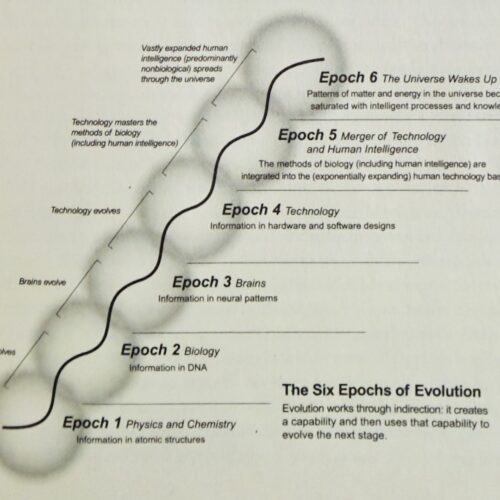
Virtual simulations are like a precursor phase to what would come later in the merger of biological and nonbiological intelligence via the Technological Singularity. Kurzweil predicts: “We will have version 3.0 human bodies, which we will be able to modify and reinstate into new forms at will” and “in real reality in the 2040s.” A blog post at KurzweilAI.net by Natasha Vita-More presents a hypothetical future body. It could be “customized” with things like “smart skin” and “replaceable genes.”
Agency vs. Determinism:
I’m imagining the future as a big Burning Man event, with people presenting themselves in expressive ways – identities becoming fluid and flexible. A Chaz Bono testimonial in a few decades could be one sentence: “Downloaded a new body, looks great, yay!”
This assumes autonomy and personal liberty won’t be subsumed by assimilation, collectivism and ‘the hive mind.’ What if instead of a gender binary, with some space to move around, advanced humans have a gendered or non-gendered identity that isn’t self-selected?
Jaron Lanier, in Who Owns the Future?
Lanier gives a hypothetical about sexual orientation that I’m about to modify to be about gender. What if you fill out the surveys on eHarmony and their algorithm says your gender isn’t inline with your own self-perception? Maybe it advises transitioning when you wouldn’t otherwise make this choice. If we give up our agency as individuals to the collective cloud, then eHarmony, Google or a Siren Server make decisions for us.
In the next century, a Human 1.0 body might not be an option – if it’s obsolete and everyone else has better systems. It could mean more freedom for us as individuals or it could mean less if our lives are no longer self-determined.
 About the Author:
Dani Pettas is a creative professional and has a background in Social Science (BA) and Advertising (career experience). Dani’s blogs at DaniPettas.com.