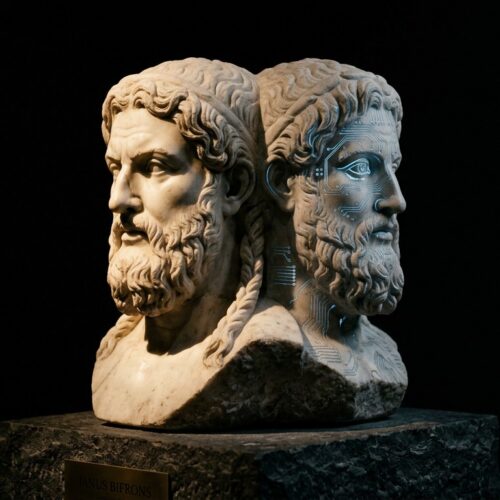
Is A Spiritual Singularity Near?
Matt Swayne / Op Ed
Posted on: November 2, 2010 / Last Modified: November 2, 2010
 The deep connection between human spirituality and advancing technology has proven to be intimate.
As our understanding of technology grows, so does our understanding of the spiritual universe, it seems.
Over the eons, our conception of God has formed and reformed into the shape of our technology. Not only that, spiritual figures are seen as a master of current and future technology.
Early man saw gods and goddesses as hunters or warriors. Statues and artwork portrayed deities wielding the latest technology of destruction–bows and arrows, spears, and, sometimes, darting about in the new model year chariot.
The Middle East, where most of our current major religions ferments, saw the rise of a God who was more like a tribal chieftain.
As the Renaissance approached, God was no longer the angry warrior. He was a clockmaker, an expert, deterministic mathematician that only a Newtonian physicist could worship.
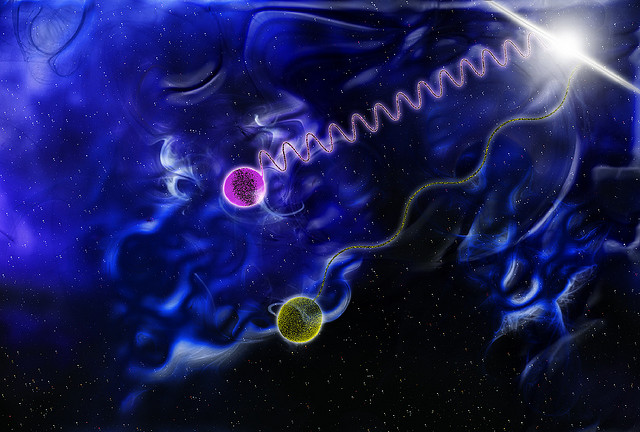
As the twentieth century dawned, the quantum mechanical revolution in physics appears to change our watchmaker description of God. God became not just a computer scientist, but a quantum computer scientist.
Profound technological change and profound philosophical change are intermingled.
It’s easy to assume that technology produced the new philosophies. But, in true chicken and egg fashion, it’s harder to define the causal relationship. For instance, new optical technology could be used to verify the earth’s new (and not central) place in the solar system. Without the spirit of discovery that dared to seek answers in a climate when answer-seeking was punishable to death, the telescope would have been nothing more than a curiosity, or conversation piece.
Looking ahead, as greater and greater technological power appears on our horizon, we can speculate how this rapid change will influence our philosophies. Maybe it will be the machine age of spirits where human consciousness will use the fabric and machinery of reality to create their own version of reality? Or, maybe it’s an age where human consciousness ends.
Or, perhaps, the Singularity must wait on us. It must wait for our imagination to adapt to these new possibilities before change is even possible.
The Singularity, then, will ultimately become less about machines. And more about spirit.
About the Author:
Matt Swayne is a blogger and science writer. He is particularly interested in quantum computing and the development of businesses around new technologies. He writes at Quantum Quant.
Related articles
- Jason Silva on Singularity Podcast: Let Your Ideas Be Noble, Poetic and Beautiful (singularityblog.singularitysymposium.com)