NOT Logic, BIOLogic: Why the AI Revolution Will Birth a Neo-Romanticism
Nikola Danaylov / Op Ed
Posted on: August 7, 2026 / Last Modified: August 28, 2026
Karl Marx knew the future. Not suspected it, not hoped for it: knew it. The proletarian revolution was absolutely inevitable. History had a direction, class struggle was its engine, and communism was its destination. You could slow the train down, but you could not stop it. Marx was a historical materialist, and his materialism came with a timetable.
Notice that history filed for divorce from that timetable. The revolution never arrived on schedule, and where its arrival was declared anyway, it had to be enforced at gunpoint. That is the part that interests me. Not that Marx was wrong; plenty of thinkers are wrong, but what the belief in inevitability did while people held it: it turned a theory into a license. If the future is guaranteed, then whoever resists the future is not an opponent to be persuaded. He is an obstacle to be removed.
Swap a few nouns, and you get Silicon Valley. Many there believe the technological revolution is absolutely inevitable. Technology has a direction, exponential growth is its engine, and the singularity is its destination. They are technological materialists. My argument is not that they must be wrong because Marx was; two claims can share a shape without sharing a fate. My argument is that inevitability claims do the same work regardless of whether they come true: they relieve believers of choice, and they relieve builders of responsibility. You cannot be blamed for a train you cannot stop.
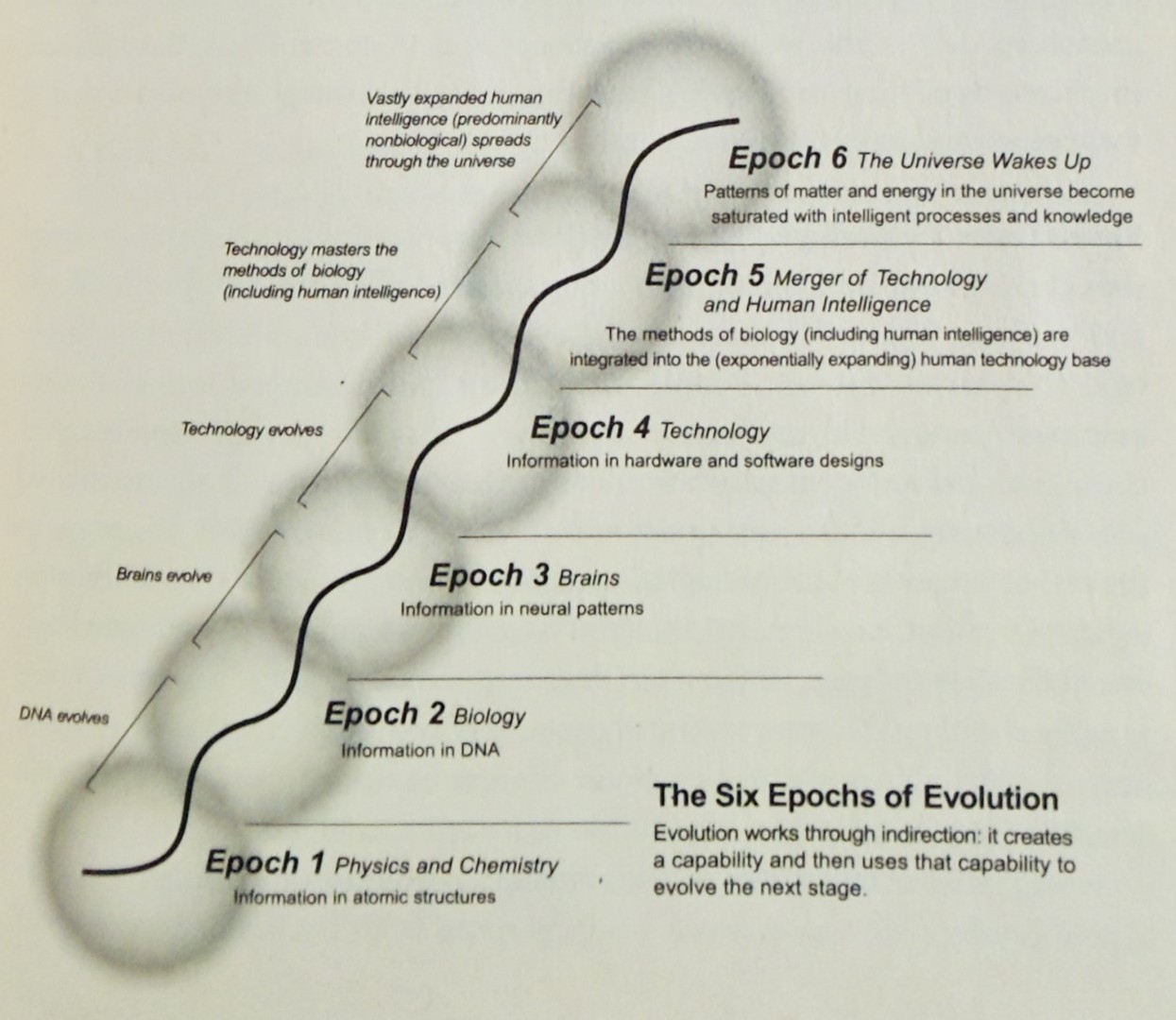
The best example is Ray Kurzweil. And let me concede upfront what his critics too often skip: the curves are real. Price-performance of computation has climbed for decades, and Ray has been checking his predictions against the data longer than most of his detractors have been paying attention. The theology begins where the graph ends. Look at his six epochs: from physics and chemistry, to biology, to brains, to technology, to the merger of human and machine intelligence, until in the sixth epoch the universe itself wakes up. A measured trend in transistor pricing becomes a cosmos that starts in dumb matter and ends in universal mind, with humanity cast as the chosen species carrying the flame from carbon to silicon. Where have we heard this before? The extrapolation is science. The destination is Genesis with graphs: the same heaven of immortality and abundance, the same providential arc.
So is the singularity a religion? In everything but name, yes. I have said it before, and I will keep saying it: this is creationism in scientific clothing.
Here is what makes the label fit, and it is not the word God. Creationism, stripped to its engine, is the claim that we are special: that Homo sapiens sits at the center of things, that the cosmos was arranged with us in mind. Science spent four centuries dismantling exactly that conceit. Copernicus moved us off the center. Darwin demoted us from the summit of creation to one twig on the tree. We now know we are a bipedal ape on an unremarkable planet, orbiting a forgettable star, in the backyard of one galaxy among billions. And then the singularity quietly hands the crown back. It tells us our intelligence is the thing the universe was building toward, that we are the chosen bridge from dumb matter to cosmic mind. It runs on the same neural wiring as any old-time religion, promises the same rewards: immortality and abundance, heaven by another name. And it does the same damage: it takes a universe of open futures and collapses them into one. That is the tell. Not the vocabulary. The structure.
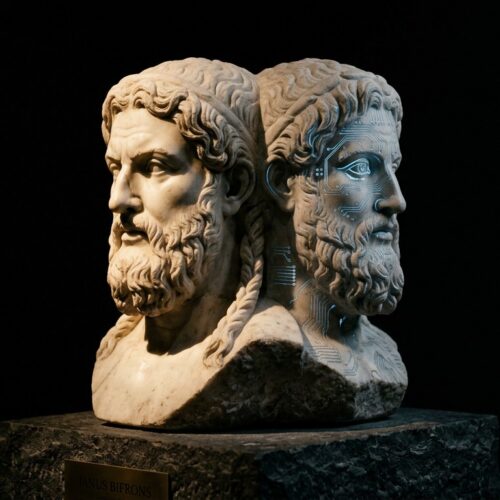
The awe itself has a genealogy, and Angus Fletcher, the story scientist I interviewed, traced it. Aristotle discovered symbolic logic, and then the world forgot it for fifteen hundred years. When it resurfaced in the Middle Ages, it resurfaced among Christian monks, the people running every school in Europe. The monks did not treat this rediscovered logic, what we now call computer thinking, as a tool. They treated it as revelation. Pure reason, untouched by flesh, doubt, or death: they were convinced they had found the mind of God. Kurzweil is no monk, and compute curves are not scripture. But when a tech luminary announces that intelligence is destiny and the universe is waking up, he is not extending the graph. He has stepped off the graph entirely, into an inheritance older than he knows. A medieval sermon delivered in Python. Fletcher likes to quote James Watson, of double helix fame, on the spirit of it: blessed are those who believe before the evidence. Watson meant it as a joke about how discovery works. The prophets of inevitability mean it as doctrine.
Full disclosure, because you deserve to know whose mirror you are looking into. I was a believer. In 2006, The Singularity Is Near blew my mind; I built a podcast and half a life on that story, and today my reputation runs the other way: the skeptic, the contrarian futurist. I profit from doubting Ray the way I once profited from quoting him, and you should discount me accordingly. Then go check the biology, because the biology does not care about my brand.
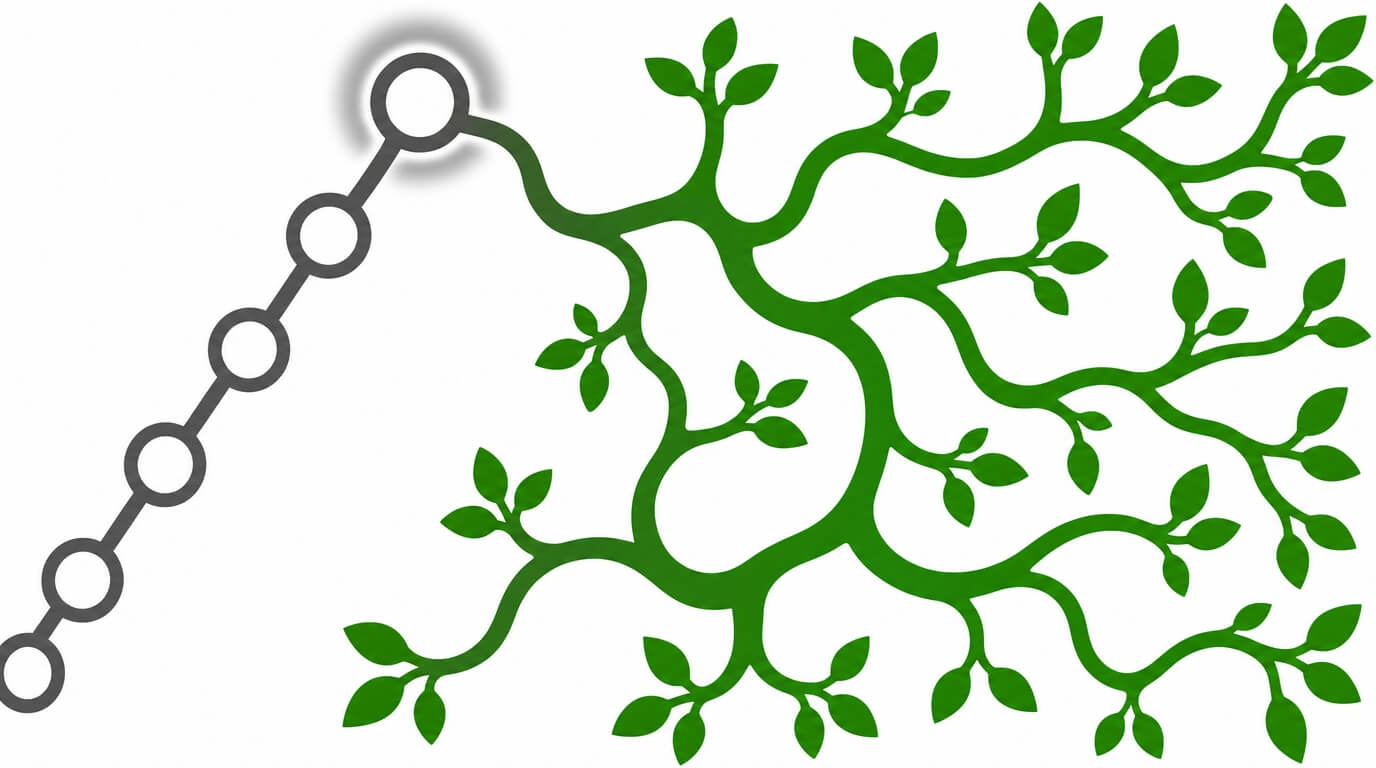
Stephen Jay Gould spent his career reminding us that evolution is a copiously branching bush, not a ladder with a summit. There is no highway running from bacteria to Bach. Bacteria are not failed humans, and humans are not failed machines. Evolution branches, wanders, forgets, improvises. I know the comeback; I have heard it in half of my interviews: fine, it branches, but look where the branches are converging. Intelligence keeps winning, so silicon is simply the next branch. Except convergence is not destiny. It is survivorship bias wearing a lab coat, reading history backward from the winner and calling the path a plan. Every ladder is just a bush described by the branch that survived to do the describing. Turn the bush into a ladder, and you have stopped doing science and started writing scripture. Put yourself, or your creation, on the top rung, and you have done something older and far more dangerous.
You have made a god.
Frank Herbert understood this better than anyone coding today.
Deep in the human unconscious is a pervasive need for a logical universe that makes sense. But the real universe is always one step beyond logic.
from “The Sayings of Muad’Dib” by the Princess Irulan, in Frank Herbert, Dune
That is the appetite the ladder feeds. The hunger is for order, not for truth, and a ladder is tidier than a bush. Herbert is not calling reason a failure. He is saying the map stays thinner than the territory, and whoever forgets that ends up building a god to cover the gap. Gods, Herbert showed us in Dune, are the most dangerous things human beings create. Not because gods are evil but because certainty is. A messiah does not need to be wrong to be catastrophic; he only needs to be believed.
A one hundred percent certain future is not a prophecy; it is a prison. And I refuse to live in one, because I already have. I grew up behind the Iron Curtain in Bulgaria, where the inevitable future was official science, printed in our textbooks and guarded by police. Yes, the historians are right that technology is never neutral clay: East and West built different machines on different budgets, and the machines pushed back on their makers. But steel mills, railways, radio, and the atom served socialism in the East, democracy in the West, and fascism in between. The decisive variable was never in the hardware. The big choices are never technological. They are ethical, which is to say political.
Technology is the How. It is not the Why or the What.
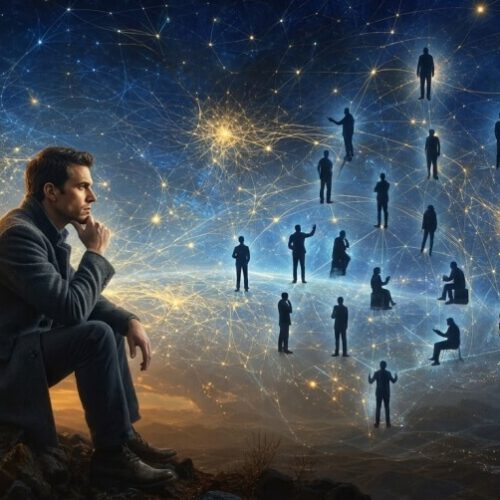
So where does that leave us? Careful now, because here is where I could make Ray’s mistake in reverse, and I would rather not. When the Enlightenment crowned Reason king, reduced nature to mechanism and man to calculation, the answer was Romanticism: Goethe, Blake, Shelley, Wordsworth. A generation that never rejected knowledge, only the claim that logic exhausts life. Mary Shelley did not write Frankenstein because she feared science but because she saw that creation without conscience, a How without a Why, breeds monsters. If Romanticism was the response to the Enlightenment, then a neo-Romanticism will be the response to the AI revolution. Is that just my own teleology, my own six epochs? No, and the difference matters. A prophecy tells you one future is coming whatever you do. A pattern tells you a response is available if enough of us choose it. I am not predicting the neo-Romantics. I am recruiting them. Its battle cry will not be Logic. It will be BIOLogic.
What do I mean by BIOLogic? The intelligence of the living: embodied, mortal, emotional, storied. Not the opposite of reason, the soil reason grows in. Fletcher makes the case in hardware terms: neurons do not run syllogisms; they run narrative, cause and effect, character and action, what happens next. A machine can chew through gargantuan amounts of data, but it must borrow its context, its whole sense of signal and noise, treasure and garbage, entirely from us. Think of Stanislav Petrov, the Soviet officer whose screens announced with perfect logical confidence that American missiles were flying. Petrov did not out-feel the machine. He out-contexted it. He asked the one question no satellite could ask: what story makes sense of five missiles, when a real first strike would be hundreds? The system had flawless data and no context. The man supplied the context; the context said false alarm, and the world got to keep existing. That is BIOLogic: not reason rejected, reason rooted.
And here is my falsifiable wager, so you can hold me to it: the day a machine originates its own context, decides for itself what matters and why, without borrowing an ounce from living beings, that is the day it stops being our tool and starts being its own branch on the bush.
Marx told the workers they were riding the locomotive of history. The technological materialists tell us we are riding the exponential. Both offer the same bargain: surrender your agency, and the destination is guaranteed.
I decline.
The future is not a prediction. The future is a story, which means it is up for grabs. You can kneel before the new god of pure reason and believe before the evidence, or you can pick up the pen, get your hands dirty, and write like something alive.
Not Logic. BIOLogic.
Because the machines will keep getting the syllogisms right. Someone still has to decide what they are for.