John von Neumann and the Original Vision of the Technological Singularity
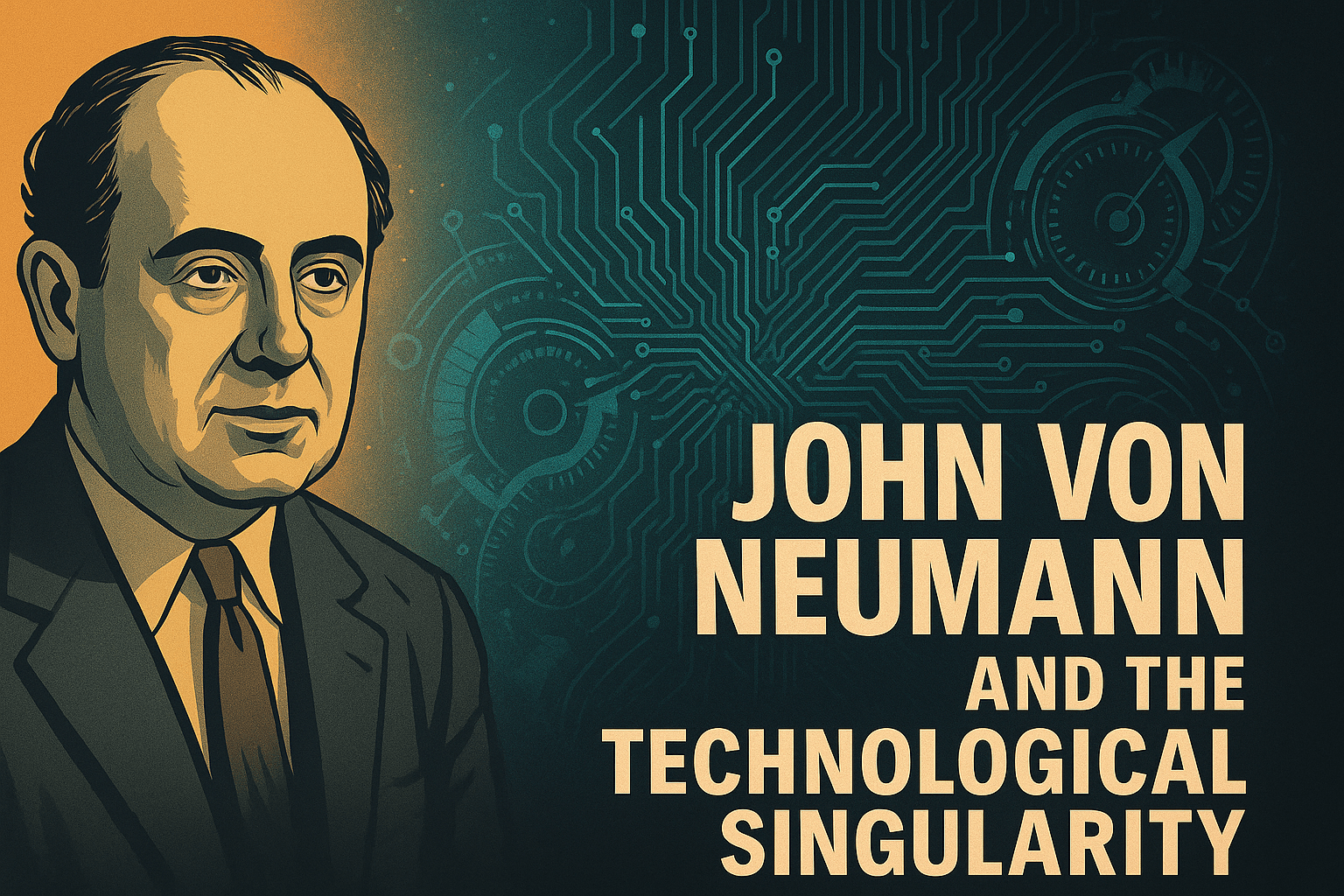 Before Kurzweil, before Vinge, and decades before ChatGPT or AGI debates hit the mainstream, John von Neumann quietly laid the conceptual groundwork for what we now call the Technological Singularity.
A mathematician, physicist, polymath, and strategic thinker of legendary scope, von Neumann is a towering figure whose work underpins everything from game theory and quantum mechanics to modern computer architecture. And yet, perhaps his most prescient insight was a warning—one that today feels more relevant than ever.
Who Was John von Neumann?
Born on December 28, 1903, in Budapest (then part of the Austro-Hungarian Empire), John von Neumann was a prodigy from the start. By the age of ten, he could perform complex arithmetic in his head. By twenty-two, he had earned dual doctorates—one in mathematics from Budapest and another in chemical engineering from Zurich.
After teaching at the University of Berlin, von Neumann emigrated to the United States in the early 1930s, joining the faculty at Princeton and later the Institute for Advanced Study. He remained there until his death in 1957.
Von Neumann contributed major breakthroughs across an extraordinary range of disciplines:
- Set theory and functional analysis
- Quantum mechanics
- Economics and game theory (co-authoring Theory of Games and Economic Behavior)
- Hydrodynamics and nuclear physics
- Early computer science, where he designed the now-standard von Neumann architecture
He was instrumental in both the Manhattan Project (atomic bomb) and later the hydrogen bomb, and he served as a consultant to the U.S. government, CIA, RAND Corporation, and IBM.
Politically, von Neumann was an unapologetic Cold Warrior. He famously advocated for a preemptive nuclear strike against the USSR, arguing it could prevent a greater catastrophe later. Whether one sees that as pragmatic realism or moral failure, there’s no question he understood the geopolitical and technological stakes of his time better than most.
The Architect of the Digital World
If you’re using a computer, smartphone, or smart fridge right now, you owe part of that to John von Neumann. His stored-program architecture remains the foundation of virtually all digital computers today.
But von Neumann wasn’t just building machines—he was asking hard questions about what those machines might ultimately mean for humanity.
John von Neumann and the Technological Singularity
It was von Neumann who, in the 1950s, first spoke of a looming event horizon in human history. As described by his biographer and colleagues, he warned of:
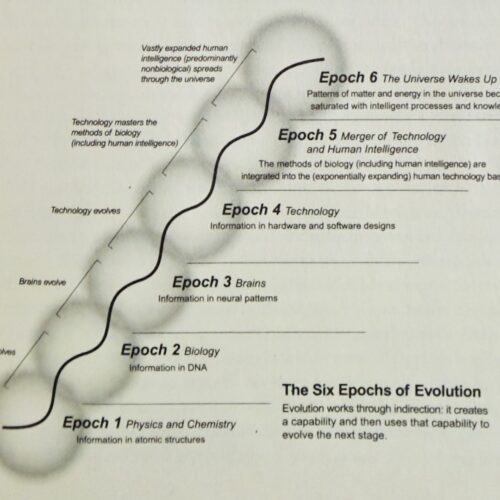
The ever accelerating progress of technology and changes in the mode of human life, which gives the appearance of approaching some essential singularity in the history of the race beyond which human affairs, as we know them, could not continue.
In other words, a moment when technological change would become so rapid and profound that human life would be fundamentally and irreversibly altered.
This wasn’t science fiction—it was sober forecasting from a man whose predictions had already shaped nuclear warfare, economics, and the digital revolution.
Von Neumann’s own working definition of the Singularity was clear:
The Singularity is the moment beyond which technological progress will become incomprehensibly rapid and complicated.
This wasn’t just about smarter machines — it was about the end of predictability itself.
Why von Neumann Still Matters
Today, “the Singularity” has become a buzzword — sometimes overhyped, sometimes misunderstood. But von Neumann’s original framing cuts through the noise.
His insights remind us:
- That acceleration is not automatically good
- That complexity can outpace comprehension
- That intelligence, once externalized in machines, may evolve far beyond its creators
- And that human affairs, as we know them, may not continue in recognizable form
In that sense, von Neumann is the true origin point of modern Singularity thinking—not in the utopian sense of transcendence, but in the sober recognition of a phase transition in civilization itself.
Remembering the Man Behind the Machines
John von Neumann died of cancer in 1957, reportedly working on the philosophy of mind and computation until his final days. His last book, The Computer and the Brain, wrestled with questions still unresolved today:
Can the brain be simulated? Is consciousness computational? Where does biology end and code begin?
In the age of AI, AGI, and exponential everything, we are finally entering the terrain von Neumann foresaw—where the future accelerates beyond familiar patterns, and where complexity threatens to overwhelm comprehension.
We would do well to revisit his warnings, not just his algorithms.