Dawn of the Kill-Bots: the Conflicts in Iraq and Afghanistan and the Arming of AI (part 1)
Nikola Danaylov / Op Ed
Posted on: December 16, 2009 / Last Modified: December 16, 2009
Warfare, while seemingly the opposite of large scale industrial production, in so far as it is usually perceived to be large scale destruction, exhibits most if not all of the main characteristics of the capitalist mode of production. Features such as specialization, personal discipline within an ethos of team spirit, standardization of procedures, processes and products, are characteristic of both war and modern production.
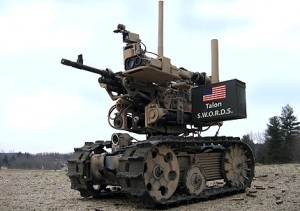
Whether it is more proper to say that warfare has been industrialized or that capitalist production has been militarized is an interesting and important question, yet regardless of the answer it is evident that robots can be successfully applied both to the production process of capitalism as well as the destruction process of war.
Just like its cousin the manufacturing robot has the capacity to produce more products per unit of time compared to a worker, a war-bot could potentially bring more and/or “higher quality” of destruction than a soldier.
At the same time, similarly to the robot, the war-bot could accomplish the above at a lower (destruction) cost, with higher precision, without the protection of trade unions, the necessity of health or pension benefits, and (allegedly) any potential for even minimal disobedience. In addition, from domestic politics point of view more war-bots are perceived as putting less (of our) soldiers in harm’s way and hence provide an added political impetus behind their fast adoption. Thus at least in the developed capitalist world today there are powerful military, political and economic incentives behind the creation of large and multifaceted robotic armed forces aimed at gradually replacing most if not all of today’s soldiers.
My thesis in this series of several blog posts is that despite the high media coverage of the conflicts in Iraq and Afghanistan what we are (not) witnessing is the rise of armed military robots capable of killing humans.
Therefore I will argue that within the history of the human species the present conflicts in Iraq and Afghanistan may eventually turn out to be known as the dawn of the kill-bots – the period during which increasingly self-sufficient machines became capable of and started making increasingly autonomous decisions about killing human beings. Thus the conflicts in Iraq and Afghanistan may turn out to be a lot more than merely a chapter in the War on Terrorism or a conflict between incompatible ideologies. What those conflicts could turn out to be is but the foreword of an altogether new type of war – the conflict between man and machine, mankind and robotkind, with democracy being the first casualty.
End of Part 1 (see Part 2; Part 3; Part 4; Part 5)
Related articles by Zemanta
- The Reuters News Kill-Bot Report (singularityblog.singularitysymposium.com)